

Traditional event tools are single-purpose: one app for registration, another for the attendee app, a third for badges, a fourth for matchmaking. Moostoo runs all of that from one admin app with one login and one analytics dashboard, so attendee and sponsor data stays connected instead of scattered across logins nobody remembers. The practical difference shows up less in any single feature and more in whether those features actually talk to each other.
Key Takeaways
- Registration, check-in, badges, networking, exhibitor tools and analytics run from one admin app instead of five or six separate logins.
- Moostoo’s AI matchmaking pairs one attendee’s stated Offers against another’s Seeks, and never matches colleagues or people at the same booth.
- A support team is there through planning and on event day: standard support up to a named contact or dedicated Customer Success Manager, depending on plan.
- Neither approach is free. A connected platform still costs money too. The difference is one bill and one dataset instead of several.
What’s the problem with stitching together traditional event tools?
Most organizers didn’t choose a patchwork on purpose. It accumulates: a registration tool for sign-ups, a mobile app for the schedule, a separate system for badge scanning, standalone networking software, a third-party streaming tool for the virtual sessions, and a spreadsheet to pull it all together for the ROI conversation with sponsors.
- Registration platform
- Mobile schedule app
- Badge scanning / check-in system
- Networking or matchmaking software
- Streaming tool for virtual sessions
- Spreadsheet or BI tool to stitch the data back together
Each one might do its own job well. Together, they create a different set of problems: attendees land in a different app for every part of the day, staff spend the week before the event relearning five vendors’ quirks instead of one, every vendor is its own contract and renewal, and nobody has one number for how the event actually went: just six exports that don’t line up.
What does Moostoo put in place of that stack?
This is what people mean by an all-in-one event platform, in practice: one admin app that covers the event lifecycle end to end.
- Registration & check-in: sign-up forms, badge design and printing, and entrance or session check-in, all writing to the same attendee record.
- AI matchmaking: matches what one attendee offers against what another is looking for, plus profile answers and company data, and never pairs colleagues or competitors.
- Networking & engagement: 1:1 meeting requests, in-app messaging, and a post-event report that’s still readable once the event is over.
- Sponsor & exhibitor tools: booth pages, booth meeting sessions and lead capture that feed the same ROI dashboard sponsors see.
- Streaming & virtual sessions: live and on-demand sessions inside the same attendee app for hybrid and virtual programs.
- Analytics & reporting: one dashboard for registration pace, attendance, networking activity and sponsor ROI, before, during and after the event.
- A support team: live through setup and event day, scaling from standard support up to a dedicated Customer Success Manager on higher-tier plans.
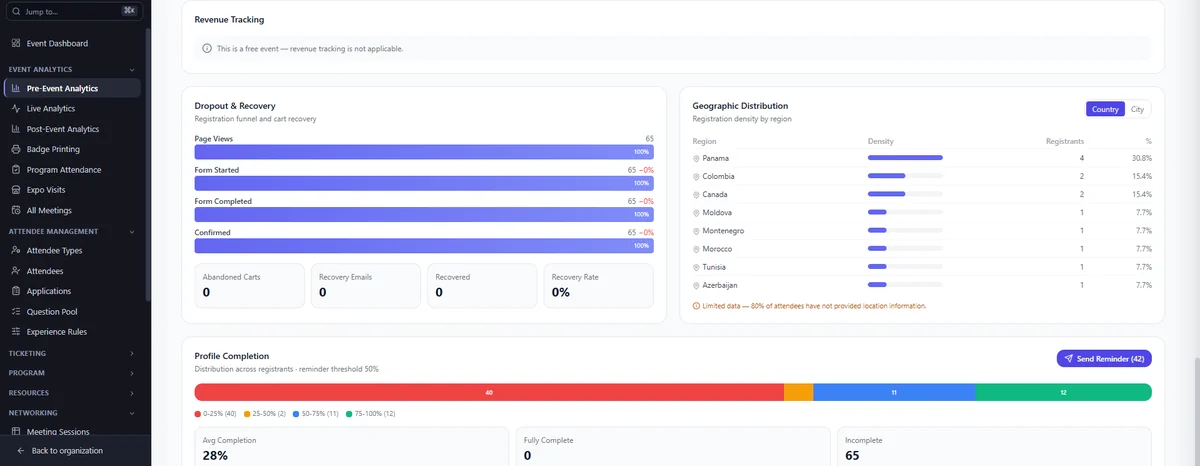
One Nav, Not Six Logins
Pre-event analytics inside the Moostoo admin app. Badge printing, program attendance, ticketing and networking sit in the same left-hand menu as this report, instead of six separate tools with six separate logins.
How does a traditional stack compare to Moostoo, side by side?
| Traditional Tools | Moostoo |
|---|---|
| Separate logins, contracts and vendors for each tool | One admin app, one login |
| Attendee and sponsor data spread across systems | One analytics dashboard, pulling from the same event record |
| Networking left to chance in a room | AI matchmaking based on stated Offers and Seeks |
| Attendees juggle several apps and inboxes | One attendee app for schedule, badge, networking and messages |
| Support quality depends on which vendor you reach | One support team: standard through dedicated CSM, by plan |
| Every tool is its own line item and renewal date | One bill instead of several |
What do you actually gain by switching?
Simplicity
Staff learn one system instead of five vendors’ login screens, support lines and quirks. That’s a bigger deal on event-day morning than it looks in a sales deck.
Engagement
Networking runs on stated intent (Offers matched against Seeks) rather than who happens to be standing near the coffee, and it keeps going after the closing session through the post-event report and any follow-up campaigns an organizer sets up.
ROI
Sponsors and organizers read the same post-event report (booth visits, leads captured, meetings booked, session attendance) instead of reconciling exports from three different tools by hand.
Human + AI Support
The AI drafts things: a Networking Summary, a suggested first message. People handle the rest, from setup questions to the call when a kiosk jams on event day. How much of the “people” part you get is set by plan, not a blanket promise.
What does this look like at a real event?
For the second year running, Five Star Conference in Dallas ran check-in, badge printing and matchmaking on Moostoo instead of a stack of separate vendors. Across four days and eight self-service check-in kiosks, more than 1,300 attendees checked in with a badge designed and printed on the spot, and attendees booked over 500 meetings through the AI matchmaking in the event app. Registration stayed on Five Star’s existing platform, Swoogo, synced live into Moostoo rather than replaced outright. That last point matters: switching to one platform for everything else doesn’t require ripping out a ticketing tool that’s already working.
Key Takeaway
Traditional tools get the individual job done, but the cost shows up at the seams: more logins, more renewals, more exports that don’t match. Moostoo’s bet is that the lifecycle holds together better as one system than as six good ones stapled together: one platform, a matchmaking mechanic you can actually point to instead of guesswork, and a single dataset instead of scattered spreadsheets. If you’re comparing the two for your next event, see how the plans are packaged or read how Moostoo compares to a networking-first platform like Swapcard for a narrower, feature-by-feature view.
Frequently Asked Questions
What’s the real difference between Moostoo and traditional event tools?
Traditional tools are separate, single-purpose apps: a registration tool, a schedule app, a badge system and a networking app, each with its own login and its own export. Moostoo runs all of that from one admin app and one attendee record, so the data from check-in, networking and sponsor activity stays connected instead of needing to be stitched together afterward.
Is switching to an all-in-one event platform like Moostoo cheaper than running separate tools?
It can be, mainly by removing the overhead of several contracts, renewals and logins rather than any one tool being underpriced. Moostoo doesn’t publish prices — plans are quoted against your attendee count and event days — so the honest comparison is to add up what your current stack actually costs, including staff time, and compare that quote against it.
Does Moostoo replace every tool in an event tech stack?
For most of the stack, yes: registration, check-in and badges, networking and matchmaking, exhibitor and sponsor tools, streaming for virtual sessions, and analytics all run inside Moostoo. The one thing it doesn’t force you to replace is your existing ticketing platform. Eventbrite, Swoogo, Tito or Lu.ma can keep selling tickets and sync live into Moostoo for everything else.
Does Moostoo offer 24/7 support?
Support is tiered by plan rather than a single blanket promise: standard support on the entry plan, rising to priority support and eventually a named account contact or dedicated Customer Success Manager on higher-tier plans. See the current tiers on the pricing page, or ask your account team what’s included at your event’s size before you assume a specific response time.
Can I keep my existing registration or ticketing tool and still use Moostoo for everything else?
Yes. Moostoo connects to Eventbrite, Swoogo, Tito or Lu.ma over a live sync, so ticket purchases become attendee records automatically and you keep running check-in, badges, networking and analytics on Moostoo without rebuilding registration from scratch.
If you want to see the admin app against your own attendee count and event days, book a demo and bring your current tool list — we’ll walk through what moves over and what stays exactly as it is.
Ready to boost your engagement?
Make your next event unforgettable with AI-powered attendee engagement.
